 JUXIN FOOD EQUIP


Что вызывает чрезмерно быстрый износ ножей костного дробилка?
4Bone crusher blades wear fast mainly due to hard impurities, improper feeding, wrong blade-liner gaps or vibration, poor maintenance, and low-hardness blades.
View detailsПоиск по всей станции
The frozen meat grinder is vital pre-processing equipment for meat products. It can grind frozen meat blocks directly without complete thawing and is widely used in the production of prefabricated food, sausages and meatballs. During long continuous production, the machine may suffer poor discharging, uneven meat particles, motor overload and material leakage. Timely troubleshooting can reduce downtime losses and ensure stable operation of the production line.
The most common issue is slow or no material discharge. Main causes include frozen meat harder than the machine’s processing limit, hard meat blocks stuck between the screw and plate, oversized raw meat blocking the hopper, and severely worn screw or hole plate with enlarged fitting clearance that weakens material feeding capacity. Solutions: control raw material temperature, process frozen meat at -12℃ ~ -18℃. Cut large frozen blocks in advance with a meat cutter. Inspect the screw and hole plate regularly and replace worn parts promptly. Clear jammed meat in the hopper and avoid forced startup.
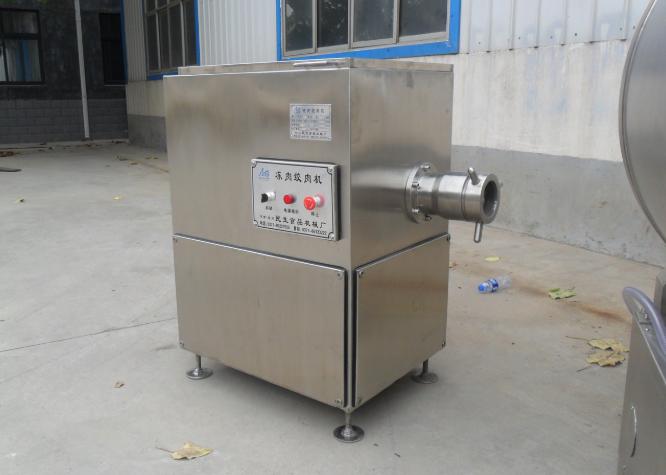
The second frequent fault is uneven ground meat particles. It is usually caused by dull blades, poor fit between blades and hole plate, or intermittent feeding. Only sharp blades can cut meat quickly. Dull edges tear muscle fibers and create irregular meat strips. Grind blades routinely. Ensure blades closely and firmly attach to the hole plate during installation. Maintain steady and continuous feeding.
Overheating and overload tripping of the motor also occur frequently in production. Frozen meat brings much higher resistance than fresh meat. One-time excessive feeding leads to sudden load increase. Inadequate lubrication at transmission parts or stuck bearings will also raise motor load. Never feed a large quantity at once; adopt small and continuous feeding. Add food-grade lubricating oil to transmission bearings regularly. If tripping persists, shut down and check for foreign objects stuck inside the grinding chamber, and restart only after removal.
Material or water leakage at both ends of the cylinder usually results from aging or damaged sealing rings or improper assembly. Leaking meat paste wastes raw materials and easily breeds bacteria. Inspect sealing rings before and after every production run, replace aged parts timely and fasten components properly during assembly.
Routine maintenance can prevent most failures. Dismantle and thoroughly clean the screw, hole plate and blades after each batch to remove meat residues. Maintain wearing parts regularly and apply lubrication. If operators are familiar with common faults and follow feeding specifications, failure rate will drop, service life of the frozen meat grinder will be extended, and continuous and stable meat processing can be guaranteed.

Bone crusher blades wear fast mainly due to hard impurities, improper feeding, wrong blade-liner gaps or vibration, poor maintenance, and low-hardness blades.
View details
Maintenance includes cleaning after each production run, daily inspection, weekly deep cleaning, monthly checks, long-term storage care, and safety precautions.
View details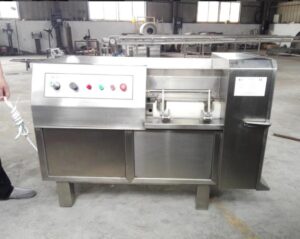
Uneven frozen meat cubes mainly stem from blade assembly, feeding, meat temperature/shape and mechanical faults; maintenance and proper settings solve them.
View details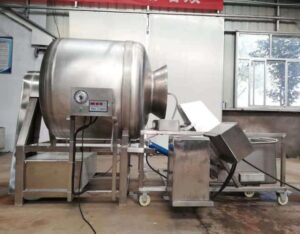
Poor vacuum tumbling causes uneven seasoning, low water retention, low yield and hard meat. Check 60–80% load, vacuum seals/pump, tumbling cycle and 0–4℃ meat.
View details

HelloPlease log in