 JUXIN FOOD EQUIP


Cómo solucionar el mal funcionamiento de la tamborila de vacío
13Poor vacuum tumbling causes uneven seasoning, low water retention, low yield and hard meat. Check 60–80% load, vacuum seals/pump, tumbling cycle and 0–4℃ meat.
View detailsBuscar en toda la emisora
Blades are key wearing parts of bone crushers. If blades wear far faster than normal, it will lead to poor crushing granularity and higher equipment load. Rapid blade wear mainly comes from raw materials, operation processes, equipment assembly and maintenance.
First, hard impurities mixed in raw materials. Foreign objects such as iron nails, steel wires and stones mixed in bones repeatedly strike cutting edges, causing nicks and scratches and accelerating blade loss. In addition, dense hard bones like cattle bones and sheep leg bones cause greater wear than pork bones. Large thick bones fed directly without pre-sorting bring huge impact load and damage cutting edges continuously.
Second, improper feeding causes jamming and squeezing of blades. Overfeeding or fast feeding leads to accumulated bones inside the crushing chamber. Blades rub and squeeze materials continuously instead of cutting normally. Tendons and grease wrapped around bones easily twine the cutter shaft and cause blockage. Blades rotate with heavy load and suffer aggravated wear. High moisture makes bone residues stick to the cutter assembly and form an abrasive layer that polishes cutting edges like sandpaper.
Third, improper equipment assembly and parameters. Too large or too small gaps between blades and liners will cause problems. Excessively large gaps prevent one-time cutting, resulting in repeated grinding. Too small gaps lead to direct friction between blades and liners. Unbalanced cutter assemblies or loose fixing bolts cause fierce vibration during crushing. Cutting edges bear alternating impact and tend to crack. Worn transmission parts and spindle runout also bring lateral force and speed up blade wear.
Fourth, inadequate maintenance. Bone residues and grease attached to the cutter assembly are not cleaned timely after production. Hardened residues keep abrading edges. Without regular inspection, dull blades keep running. Dull edges tear and rub bones instead of shearing, creating a vicious cycle of wear. Blades made of substandard materials with insufficient hardness have poor wear resistance and short service life.
Solutions: Sort raw materials in advance to remove metal and stone impurities, pre-crush hard bones; feed materials uniformly in small quantities to avoid blockage; calibrate gaps between blades and liners and tighten cutter bolts; thoroughly clean the cutter assembly after each batch; sharpen or replace dull blades in time and select high-wear-resistant blades to reduce impact wear.
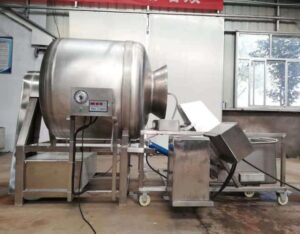
Poor vacuum tumbling causes uneven seasoning, low water retention, low yield and hard meat. Check 60–80% load, vacuum seals/pump, tumbling cycle and 0–4℃ meat.
View details
Maintenance includes cleaning after each production run, daily inspection, weekly deep cleaning, monthly checks, long-term storage care, and safety precautions.
View details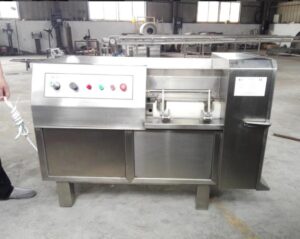
Uneven frozen meat cubes mainly stem from blade assembly, feeding, meat temperature/shape and mechanical faults; maintenance and proper settings solve them.
View details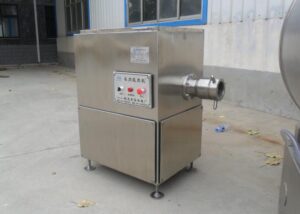
Frozen meat grinders face poor discharge, uneven particles, motor overload and leakage; timely fixes and maintenance cut downtime and ensure stable production.
View details

HelloPlease log in